


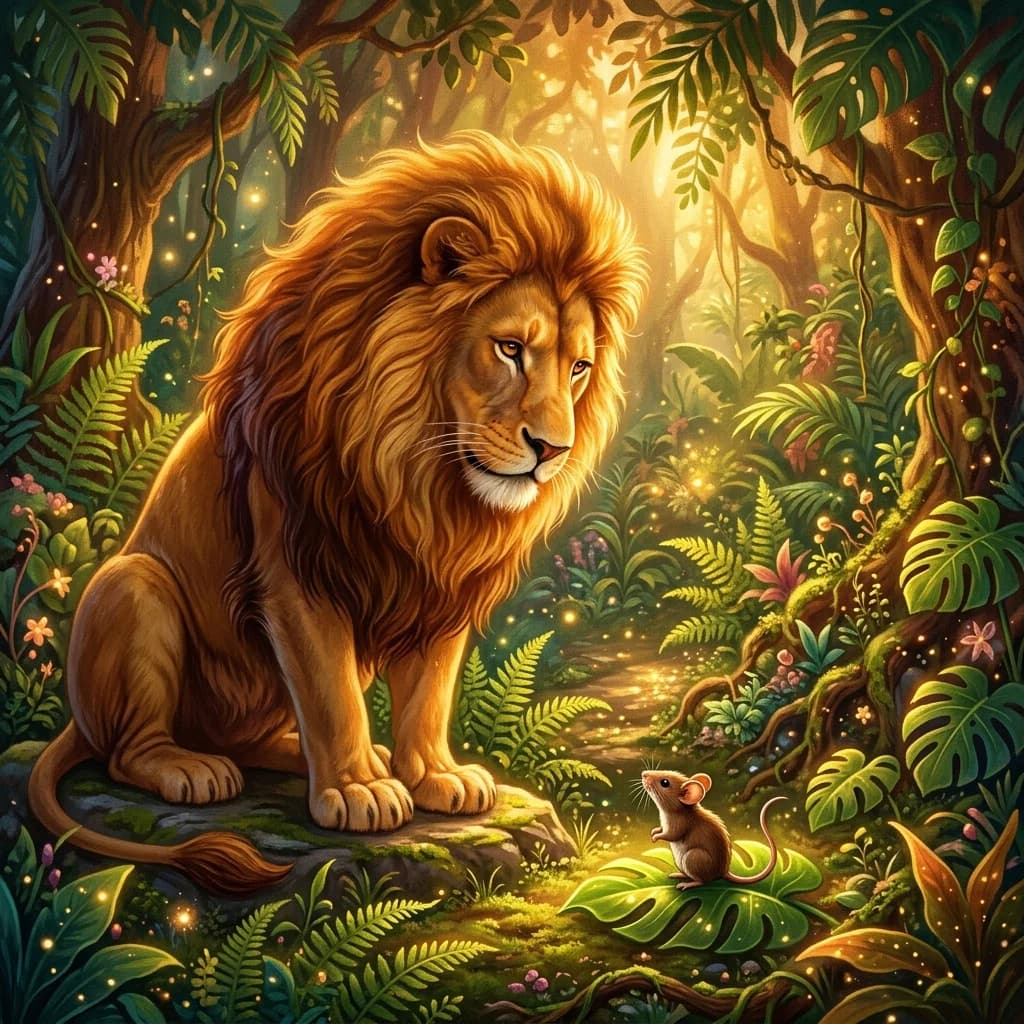
The Sleeping King
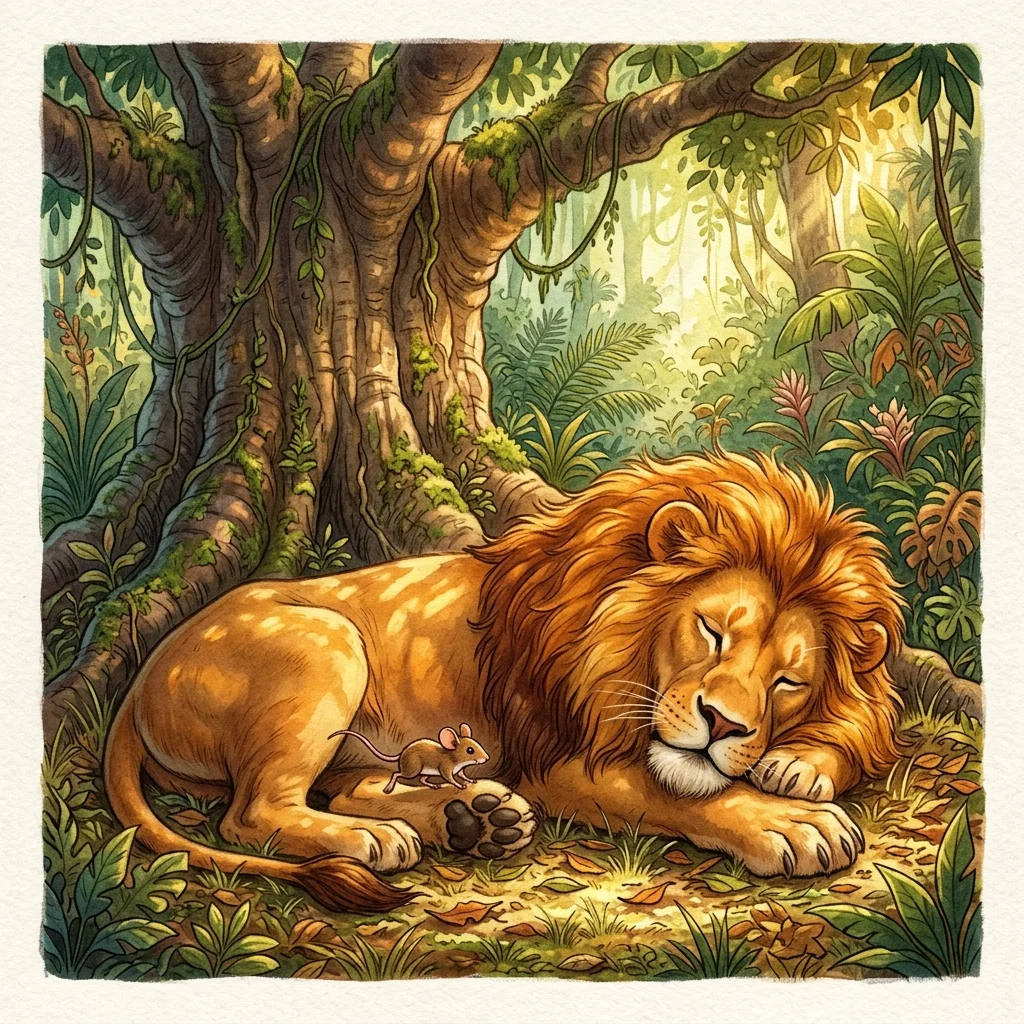
Once, in the deep shade of a sprawling baobab tree, a magnificent lion lay sleeping. The afternoon heat hung heavy in the air, and the jungle was quiet, save for the occasional chirp of a distant bird. The lion's golden mane spread out like a regal carpet across the dry earth.
Not far away, a tiny brown mouse was foraging for seeds. Distracted by her search, she scurried directly across the sleeping lion's massive paw. Instantly, the great cat awoke. With a terrifying roar, he slammed his heavy claws down, pinning the trembling little creature to the ground.
A Royal Laugh
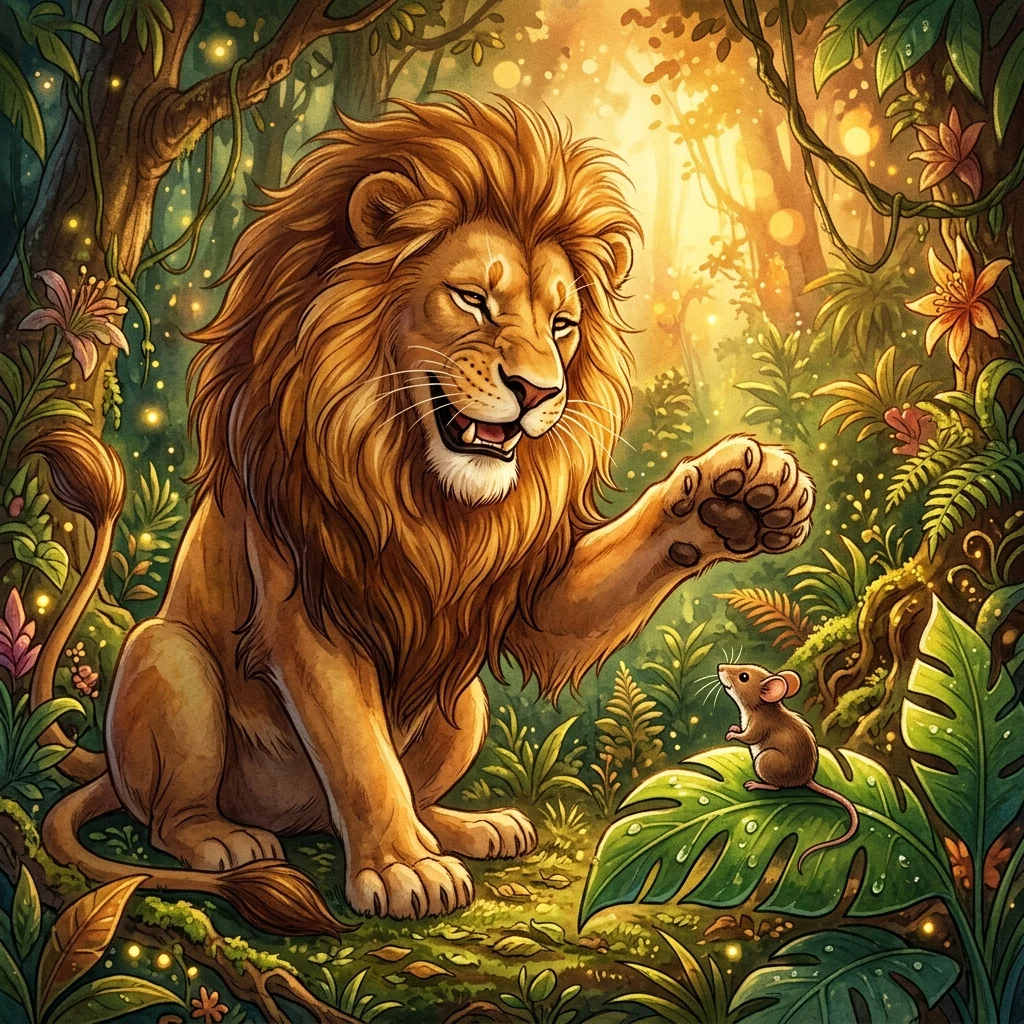
"Please, oh mighty king, spare me!" squeaked the terrified mouse. "If you let me live, I promise that one day I will repay your kindness. I will never forget your mercy."
The lion stopped roaring. He stared at the minuscule creature under his claws and then threw his head back and laughed heartily. The booming sound shook the leaves above them. The idea that a creature so insignificant could ever help the king of the jungle was absurd to him.
But the lion was in a good mood, and the mouse's bravery amused him. "Very well, little one," he said, lifting his massive paw. "Go in peace. But do not wake me again." The mouse thanked him profusely and dashed away into the underbrush.
The Hunter's Trap
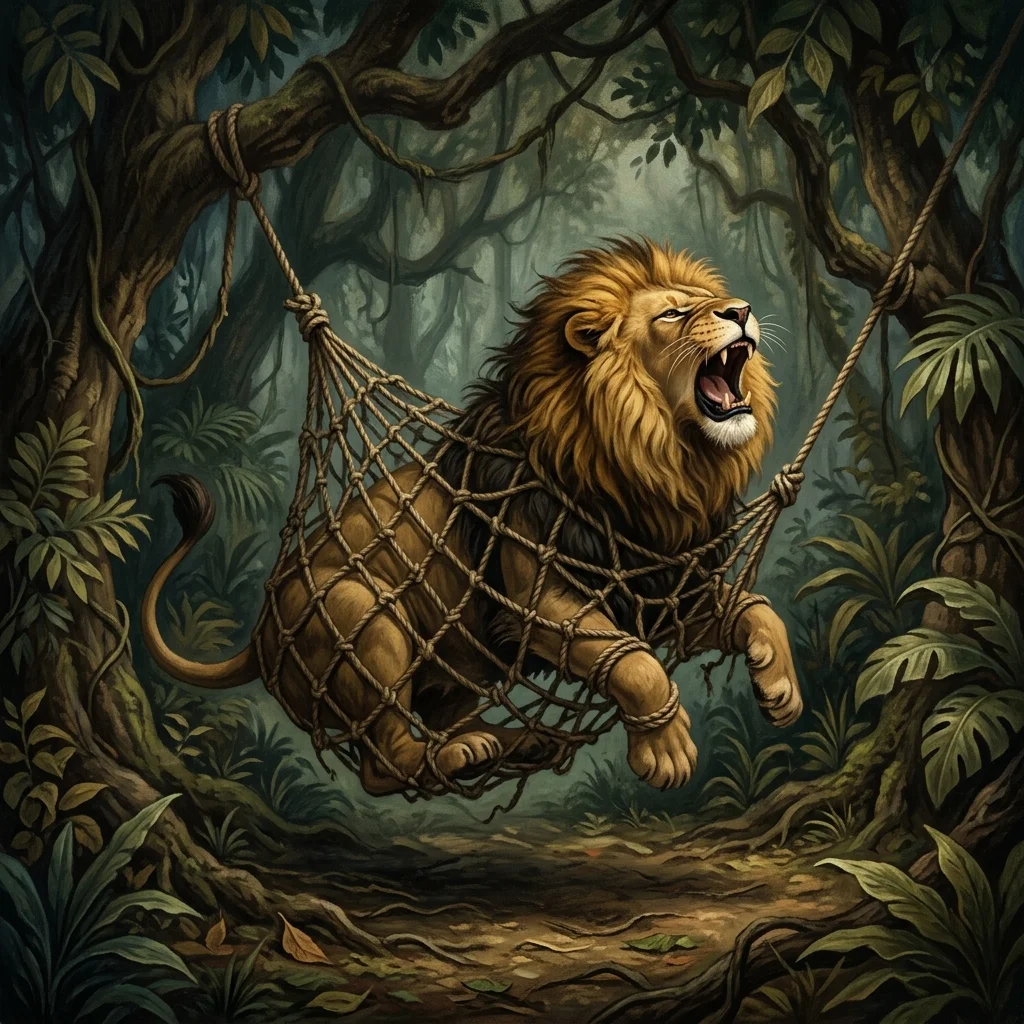
Weeks passed, and the rainy season arrived. One evening, while patrolling his territory, the lion failed to notice a hidden rope trap laid by poachers. In an instant, the heavy net dropped from the canopy above, entangling him completely.
The lion roared in anger and thrashed violently, using all of his incredible strength to tear at the thick, rough fibers. But the more he struggled, the tighter the knots pulled around him. Hopelessly trapped and exhausted, he let out a long, sorrowful roar that echoed across the jungle.
A Promise Kept
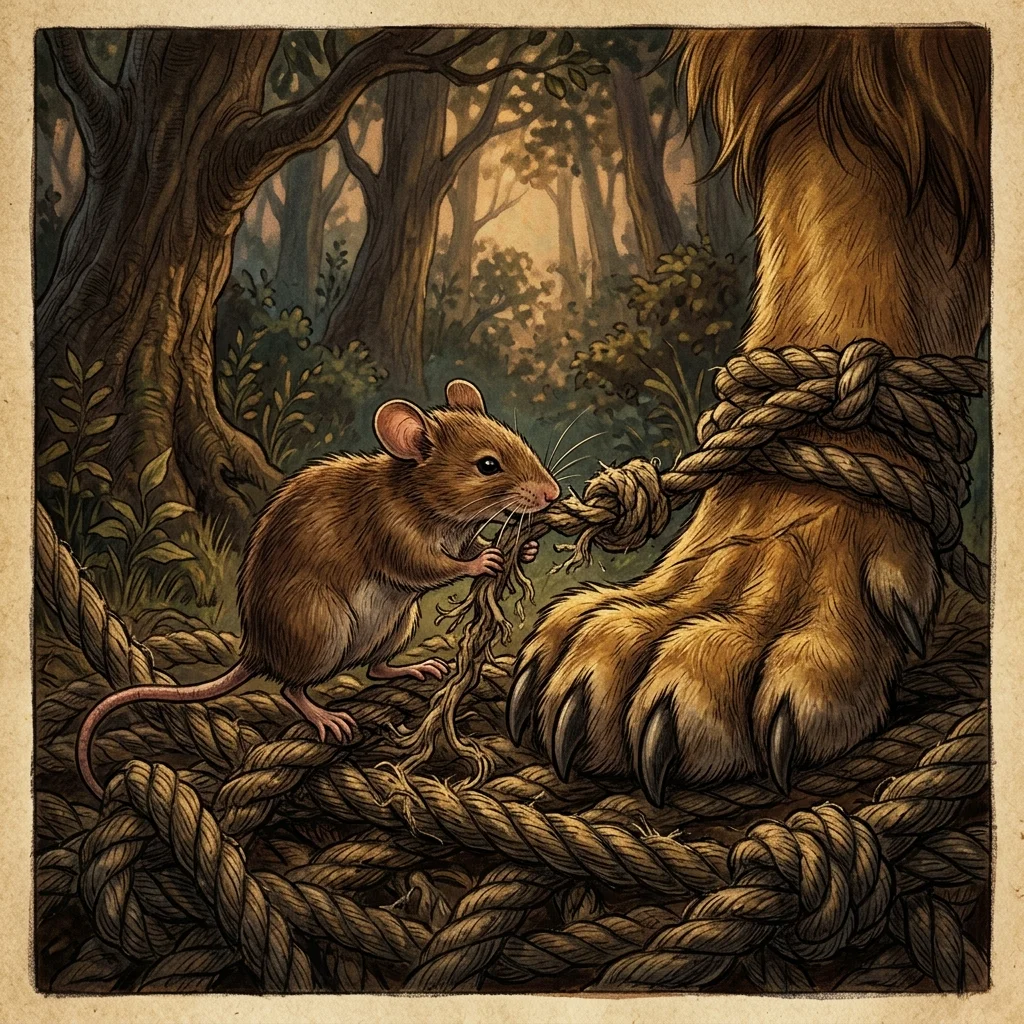
Far away, the little brown mouse heard the desperate cry. She recognized the voice immediately and scampered through the thick ferns as fast as her tiny legs could carry her. When she arrived, she found the mighty king lying defeated in the net.
"Do not worry, my friend," she whispered, climbing up the thick strands of rope. "I told you I would return your kindness."
Without wasting a second, the mouse began to gnaw at the heavy knots with her sharp little teeth. She chewed and chewed, cutting through the thick fibers one by one. After hours of diligent work, she severed the final rope, and the heavy net fell away. The lion stood up, free at last.
He looked down at the tiny creature who had just saved his life. "Thank you," he said softly, bowing his great head. "I was wrong to laugh at you. I now know that even the smallest friend can be the greatest of help."
Prowlpad Reading Notes
Attributed to Aesop — a storyteller believed to have lived in ancient Greece between 620 and 564 BCE — The Lion and the Mouse is a study in one of nature's most quietly radical ideas: that power and usefulness are not the same thing. The lion's laugh is not cruelty. It is a reasonable biological assumption. A mouse has no mass, no claws, no venom. By every measurable metric of the savanna, she is negligible. Aesop's genius is to let that assumption stand for the first half of the story, and then dismantle it entirely with a handful of sharp teeth and a length of rope.
In the ecology of Prowlpad's fiction, this is a recurring truth. The animal that survives is rarely the largest in the room. It is the one whose specific skill — a mouse's incisor strength, a tortoise's pacing, a crow's problem-solving — arrives at precisely the right moment. The Lion and the Mouse rewards re-reading as an adult: what once reads as a moral about gratitude reveals itself, on closer inspection, to be a precise argument about the nature of interdependence.