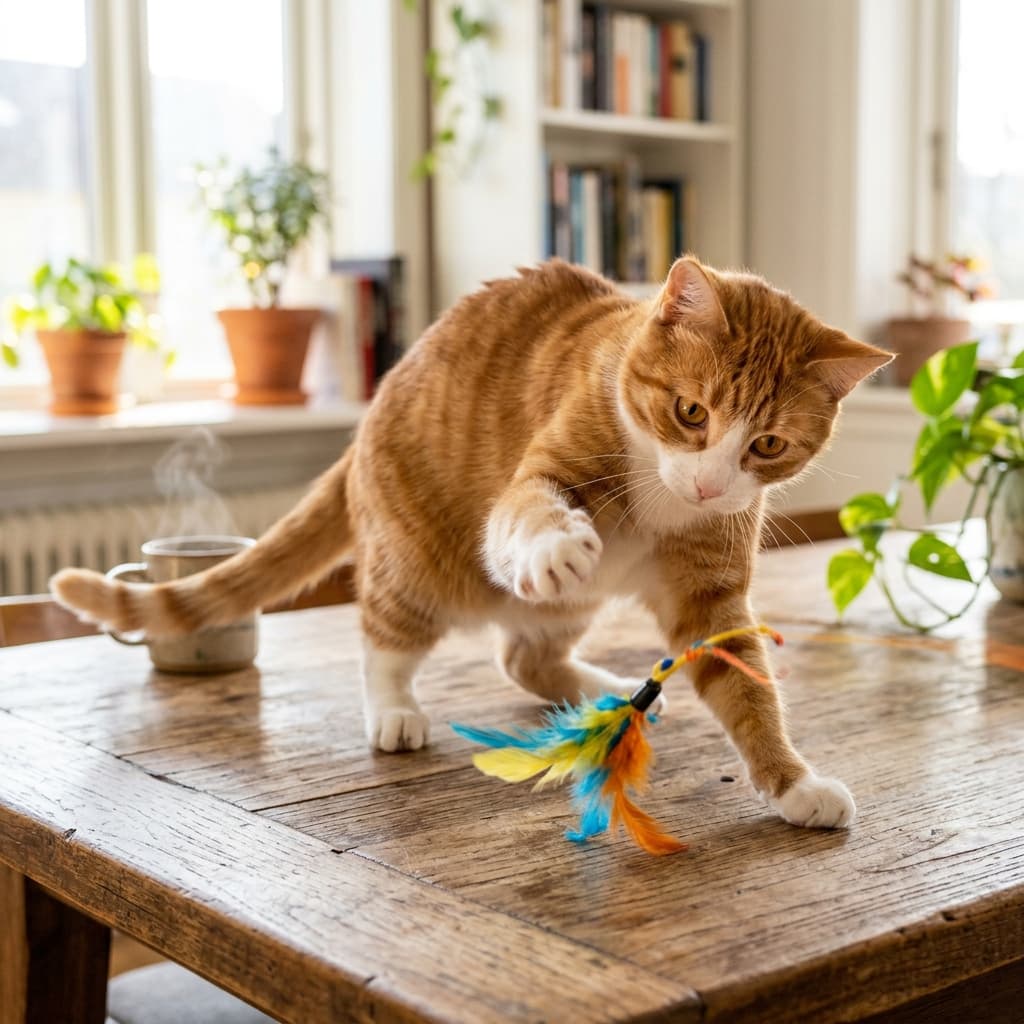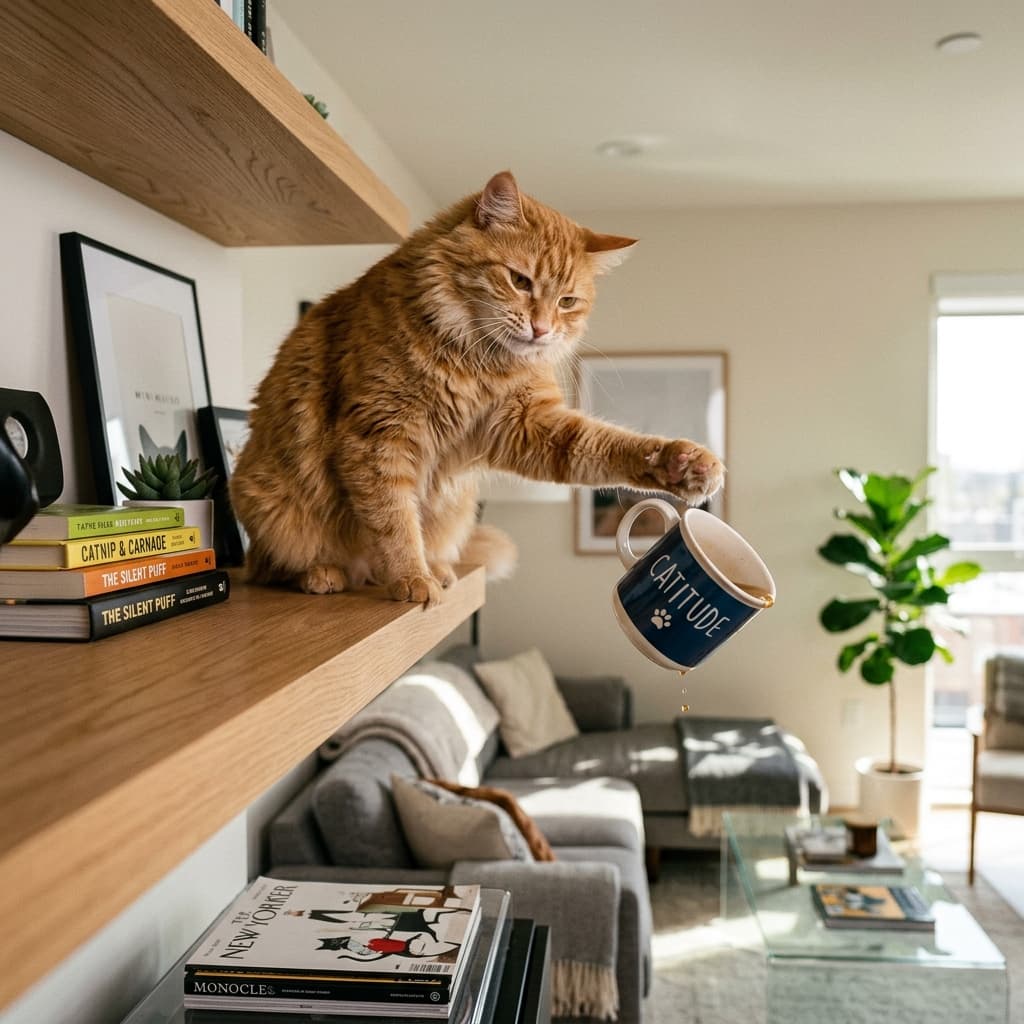
You set your glass of water on the kitchen island. Your cat leaps up, looks at you, looks at the glass, and slowly extends a single paw. They nudge the glass toward the edge. You say "no." They make eye contact and give one final, deliberate push. The glass shatters.
To a human, this looks like pure, calculated malice. To an animal behaviorist, it is a fascinating intersection of obligate predatory instincts, sensory feedback loops, and accidental human training.
Cats do not possess the cognitive architecture required for spite. When your cat knocks an object off a table, they are acting on biological drives that make complete evolutionary sense.
Cats are solitary ambush predators designed to hunt small, fast-moving prey — rodents, reptiles, birds, and insects.
In the wild, prey animals frequently play dead or freeze to blend into their surroundings. A wild felid investigating a motionless object uses its front paws to deliver tentative taps. Does the object twitch? Does it scurry? Does it squeak?
Your pen, lip balm, AirPods case, or water glass triggers this exact predatory testing sequence. When a cat paws an object toward a table edge, they are testing its kinetic properties. When the object falls and crashes to the floor, it provides a sudden burst of movement and sound — precisely what a predator's brain is wired to anticipate from a startled prey animal.
Beyond predatory testing, cats are intensely curious about environmental cause-and-effect.
Studies in feline cognitive processing show that cats possess a functional understanding of basic physics — specifically gravity and sound localization. They understand that objects move downward when unsupported, and they actively monitor the auditory result.
Different objects yield different sensory rewards:
For an indoor cat living in a static, predictable apartment, knocking objects off elevated perches is the ultimate physics experiment. It breaks the monotony of their environment with immediate visual and acoustic feedback.
This is where human psychology enters the loop.
Cats are master observers of human behavior. If your cat wants attention or food, quiet vocalizations might be ignored. But the moment their paw touches your car keys on the counter, you jump out of your chair, shout their name, and march across the room.
To a cat, this is a massive victory. You have just provided immediate, high-intensity attention.
Even if you are yelling or scolding, to a bored cat, negative attention is immensely more rewarding than being ignored. Once a cat learns that Paw + Edge = Human Runs Over, the behavior becomes a reliable doorbell they can ring whenever they want an audience.
You cannot eliminate predatory curiosity or physics testing from a cat's brain. But you can easily manage the environment and your own reactions.
When your cat knocks something over, do not react. Do not yell, do not look at them, and do not rush over to pick it up. Wait until the cat has wandered away to clean up. If pushing objects off tables yields zero human reaction, the attention-seeking component of the behavior extinguishes itself.
Management is easier than retraining. Move glass, ceramic, electronics, and small objects away from table edges or into closed drawers. Use museum putty (mounting putty) under decorative items on shelves to anchor them firmly.
A cat that knocks things over is telling you their hunting drive is unfulfilled. Dedicate 15 minutes twice a day to interactive play with a wand toy. Allow the cat to stalk, chase, pounce on, and physically "kill" the toy, followed immediately by a meal or treat. This completes the natural Hunt-Catch-Kill-Eat-Sleep cycle, leaving their nervous system satisfied and quiet.
Your cat is not a villain plotting your frustration. They are a finely tuned predator and environmental scientist operating in a human-built landscape. Once you understand the engine behind the behavior, the broken glasses stop feeling personal.
Yes. Cats intentionally knock objects over to see how they fall, hear the sound they make, or test whether the object will run away like prey.
No. Cats lack the human concept of spite or malice. They knock things over for entertainment, attention, or instinctual investigation.
Provide alternative high places like cat trees nearby. Make the counters unappealing by temporarily placing double-sided tape on the edges until the habit breaks.
They check to see if you are watching. If they learned that knocking an object over gets your attention, they verify they have an audience before performing the action.
Sudden behavior changes in older cats can signal cognitive dysfunction or a desire for attention due to underlying pain or illness. Schedule a vet check.