George Orwell wrote Animal Farm during World War II and could not get it published. Four London publishers rejected it. They were afraid of upsetting the Soviet Union — Britain's ally at the time. When it finally came out in 1945, the book ran to 112 pages. It had been written in under three months.
That small, rejected book is now one of the most widely read novels in human history. It is assigned in schools across more than 40 countries. It has been translated into over 70 languages. And the question every new reader asks when they finish it is: how did Orwell do that?
The answer is deceptively simple. When you read a story about human politicians — even fictional ones — your biases engage from the first page. You recognize types, assign tribe affiliations, and your political defenses go up. You read the antagonist through the lens of your own assumptions about power.
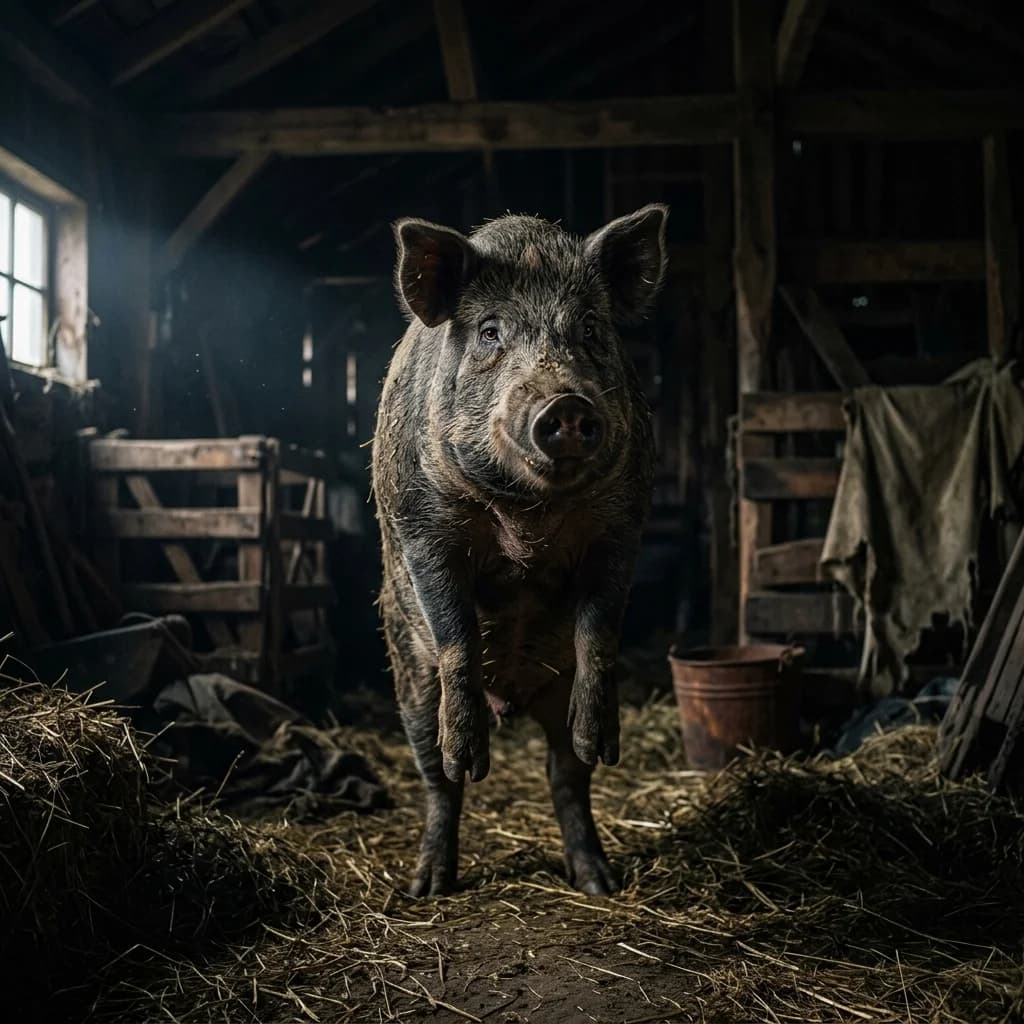
Replace the human politician with a pig, and something different happens entirely. You watch a pig steal milk and apples. You evaluate the pig's behavior with clean eyes. You understand what is happening — the hoarding, the manipulation, the justifications — and you understand it as wrong, without any prior political category clouding your judgment.
By the time you realize the pigs are a direct portrait of Stalin's Politburo, the moral is already inside you. Orwell used fiction's oldest structural trick — the animal fable — and wielded it with lethal precision.
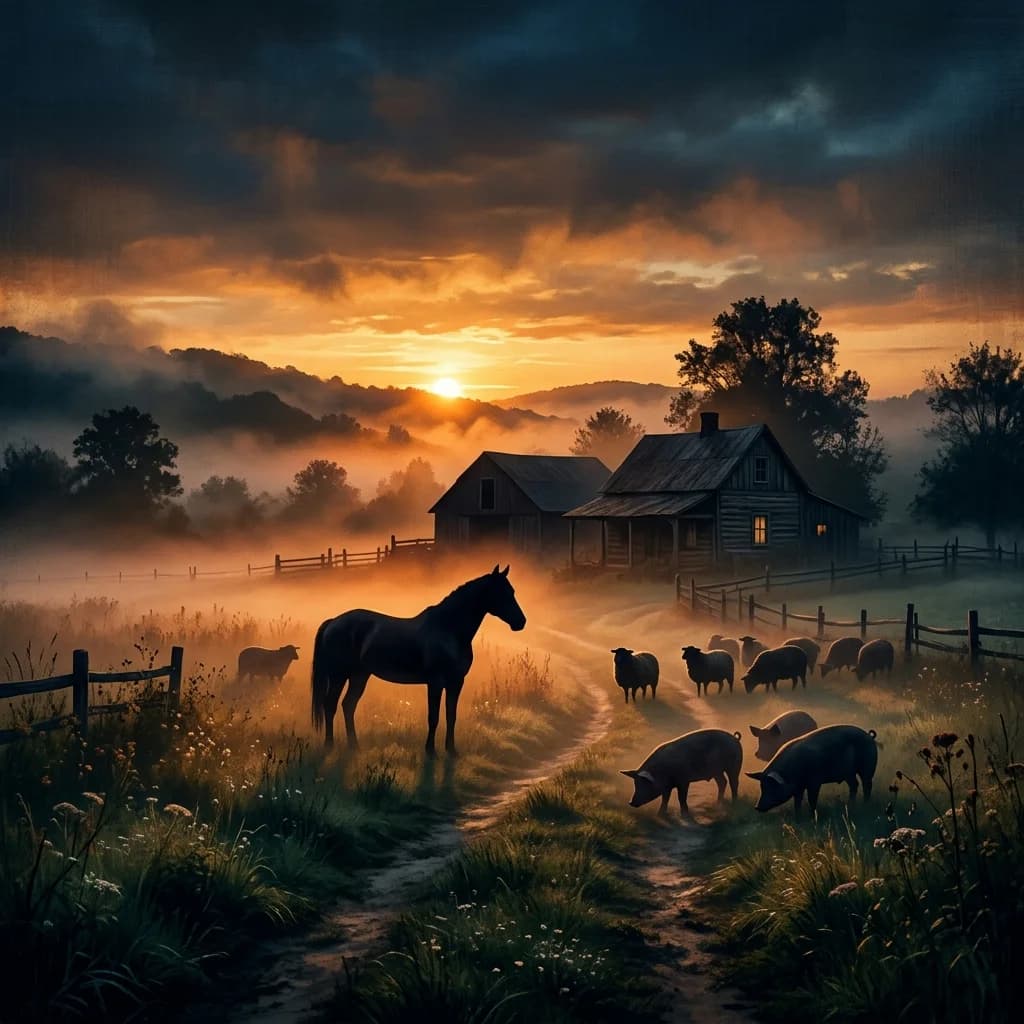
Orwell did not choose farm animals arbitrarily. He chose them because each species already carries deeply embedded cultural associations, and he used those associations to communicate character instantly.
The pigs are intelligent, dominant, and associated with greed. The moment Napoleon takes charge, the reader already knows exactly what Napoleon is.
Boxer the horse is loyal, strong, and incapable of imagining that the pigs could betray him. Boxer is the working class. When he is sent to the knacker's yard, it is one of the most quietly devastating scenes in twentieth-century literature — not because Orwell wrote it as tragedy, but because he wrote it as bureaucratic fact.
The sheep are not stupid — they are manipulated. They repeat slogans they do not fully understand. They are not a criticism of working people; they are a precise portrait of how propaganda functions in any society.
The dogs are the secret police. They enforce without question. Orwell never needs to explain what they represent because the reader already knows.
This is archetypal distillation at its finest. The animals communicate their political roles through biological fact, not authorial intervention.
The final scene of Animal Farm is the novel's most important paragraph. The pigs have invited the human farmers to dinner. The other animals look through the farmhouse window at the gathering inside:
"The creatures outside looked from pig to man, and from man to pig, and from pig to man again; but already it was impossible to say which was which."
This is not a metaphor. It is the actual, logical endpoint of the story Orwell was telling. Power, once seized and held, transforms those who hold it into the thing they overthrew. The revolution does not fail because of betrayal. It fails because of the nature of power itself.
No human political novel of the twentieth century delivered that argument more effectively. And none of them could. The animals are the argument. Without them, it is just history.
Animal Farm is not a period piece about the Soviet Union. It is a permanent diagnostic tool. Every generation finds a new application for it, because every generation produces new hierarchies, new propaganda machines, and new Boxers who work themselves to exhaustion in service of leaders who do not deserve them.
The novel's continued relevance is sometimes cited as a failure — evidence that human society never learns. I would argue the opposite. The fact that readers still recognize Orwell's pigs in contemporary politics means the book still functions exactly as intended: as a mirror that cuts through allegiance and makes the pattern visible.
That is what the best animal fiction does. It removes the noise of human identity and shows you the underlying structure.
Read Animal Farm once and you get the plot. Read it again — knowing the ending — and you understand why Orwell called it a "fairy story." The fairy story is the only genre honest enough to tell you that truth straight.
Governments banned it because it exposed the mechanics of totalitarian regimes. The Soviet Union banned it immediately. Other nations censored it fearing it would spark anti-government sentiments among the working class.
The pigs represent the Soviet leadership. Napoleon directly mirrors Joseph Stalin. Snowball represents Leon Trotsky. Squealer acts as the government's propaganda machine, manipulating truth to control the other animals.
Absolute power corrupts absolutely. The leaders of a revolution often become identical to the oppressive rulers they originally overthrew once they secure control of the resources.
The pigs invite the human farmers over for a card game. The other animals look through the window and realize they can no longer tell the difference between the pigs and the humans.
Yes. Many modern authors publish serialized web novels using animal protagonists to explore current themes like climate change, survival, and technology outside of traditional publishing constraints.